“To be a star, you must shine your own light, follow your own path, and don't worry about the darkness, for that is when the stars shine brightest”

Wednesday, January 28, 2009

Freemasonry or Templar - You Choose


Ever since I became a Freemason I have always wondered how the Masonic fraternity became associated with the Templar’s. Of course my research hit upon many mythical and embellished stories, often with no basis in reality.
Not long ago I read a posting by another Brother; he was having a hard time deciding if the Templar path would conflict with his beliefs and that of the Templar’s. He is a Freemason, but does not follow a Christian path.
I, myself, found his predicament interesting.
I must admit I truly love Google Books, it was there I found this wonderful article written by a Brother in 1904, and I thought I would share it with you, and hopefully the Brother who was looking for a little Light on the subject.


"IN HOC SIGNO VINCES"
BY A KNIGHT TEMPLAR (1904)

ALTHOUGH the confraternity of Knights Templar is intimately identified with Freemasonry, no philosophical or metaphysical relation exists between them. Masonry is the most ancient of all religio-philosophical systems, but its real teachings are veiled in allegory and illustrated by symbols, while Templarism is primarily a Christian military order of comparatively modern origin.
According to the philosophy and science of masonry, man's whence and whither is a mystery whose solution is to be found only in the realm of the occult through the esoteric meaning of Masonic symbols and rites of initiation. That is the only key that will unlock the door that opens into the Divine Temple of Wisdom, wherein is found the purpose of individualized life.
On the other hand, Templarism teaches that the solution of the problem of life must be sought in the New Testament, and as interpreted by the Roman Catholic Church.

Masonry is a mystical religion-philosophy based on the law of evolution of the soul from the mind of Causation, God-like effects and attributes, which is symbolized in its beginnings by a "rough Ashlar," a shapeless stone, and in its finishings by a perfect Ashlar or cube, whose perfection is attested by the plumb, the level, the square and the compass.

Templarism rejects the doctrine of evolution and also the doctrine of an overruling Providence that directs the concerns of the universe and of humanity according to natural law, and holds that God's will and pleasure are manifested in His revealed word and expressed in miracles, which in turn are the basis of faith in the truth of God's doctrine of salvation through the atonement of Jesus the Christ, hence the vessels of the church and the means employed by the Lord Christ through his vicars and ministers are altogether sacred.

All this masonry rejects, and attaches sacredness to the esoteric or occult meaning of the numbers Three, Five, Seven and Nine, with Ten representing the Perfect Number, or the mystery of Causation or God to manifestation in individualized life. The initiate in esoteric masonry turns to philosophy, history, physical science, classical literature, ethics, art, architecture, esotericism and occultism for Light and Wisdom, and he should conform his conduct of life to the doctrine of the universal brotherhood of man and the interdependence of all that lives.

Templarism includes none of these declarations and obligations. It stands for war, religious conquest, the support of such Christian dogmas as are adopted and proclaimed by the Vatican, and the brotherhood of "those of the faith."

The symbolism of masonry, with its allegorical veiling, is co-existent with the beginnings of the Aryans, who were the first fruits of evolution's civilizing processes. Templarism was born of hatred of Islam, and was reared on efforts to recover the Holy Sepulchre at Jerusalem from the defilement of Mohammedan possession. There is, therefore, nothing in common between the origin and purpose of masonry and templarism, yet there is a bond of fraternal consanguinity, albeit it was originally the product of the need of mutual advantage and protection.

Nevertheless, esoteric masonry "has stood, stands and will stand,'' as Simon Magus puts it, for universal brotherhood and for still better conditions of existence for humanity, while templarism has stood, and in theory at least stands, and must stand for a brotherhood restricted to such Christians as proclaim allegiance to the authority of the Catholic Church. This every Knights Templar knows, for does he not know that he is in honor bound to "draw his sword in defense of the Christian religion," but for no other? And was not templarism born and christened in the Catholic Church? And does not "defense" mean full and unqualified acceptance of the miraculous birth, Resurrection and Ascension of Jesus? He is not a well-informed Mason, though, who does not recognize in the Magi who assembled about that manger in Bethlehem, Brothers of the White Lodge of Esoteric masonry giving loyal allegiance to the new "Worshipful Master."

The confraternity of Knights Templar of to-day includes three orders of knighthood, viz., Knights Templar, or Knights of the Temple; Knights Hospitaller of St. John of Jerusalem and Knights of Malta. One of the orders is often called "Knights of the Red Cross," and it got that sobriquet from a fiery speech addressed to its members by the Pope on their departure for the seat of war, in which he said: "God wills it." "Let this word (of God) be adopted as your battle cry to animate the devotion and courage of the champions of Christ. His cross, as a symbol of salvation ; wear it, a red, bloody cross, as an external mark, on your breast and shoulders, a pledge of your sacred and irrevocable engagement."

The beginning of these Templar orders of knighthood dates from soon after the return of Peter the Hermit from a pilgrimage to the Holy Sepulchre, which was about twenty years after the conquest of Jerusalem by the Turks—about 1095. Peter saw how the Turks were defiling the holy place and brutally treating Christian pilgrims, and in his wrath he cried : "I will rouse the martial nations in your cause," which he did, and for more than two centuries thereafter war raged most ferociously. Seven separate crusades were undertaken under the leadership of these three orders of Knighthood. How many men, women and children perished during those stormy times historians give no very clear estimate, but it is known that over 300,000 lives were sacrificed before the first crusade was fairly under way.

But the Templars grew so rich and so arrogant—exacting $5,000,000 annually from England alone— that the Vatican was obliged on many occasions to practically interdict the order. The order assumed the right to divide Europe into provinces and demand allegiance from kings and princes, and presumed to question the authority of the Vatican itself. This would indicate that the order grew to enormous numerical proportions, which it did. Its organization in the latter part of the Twelfth Century, when it was in its greatest power, was divided into commanders, knighted priests and serving brethren.

The latter were strong in numbers and when not serving in the ranks, they employed themselves at mechanical and common labor. As handicrafters they were very much like the building trades of to-day, with quite as much arrogance and contempt for the rights of property owners. And as to-day, they became, a terror wherever they were strong enough to override opposition.

The fraternity of operative Masons and they got along very nicely together, and a few centuries later practically amalgamated. In those days, operative masonry was a mechanical art and exoteric, but speculative masonry was esoteric and occult, and was patronized by many mystics, philosophers, scientists and scholars generally. All met together upon a common level when called from "refreshment”to “labor,’ but nowhere else was there a "common level," nor were the symbols ever given their esoteric meaning to professional craftsmen. The educated Templars naturally turned to the symbols in their deeper and occult meaning. It was in this way that masonry and Templarism became identified the one with the other.

But several centuries before these happenings, the Church anathematized the Templars, not, however, until Clement V had confiscated the order's vast possessions. Subsequently, John XXI agreed to the reintegration of the order and the restitution of its property if it would abandon its old name, pledge allegiance to Church authority in any event, and adopt the name of "Knights of Christ." Only a comparatively few Templars accepted the Pope's proposition. Those who refused banded together rather closer than ever, and defied the Church. This was in 1317, and from that time to the present day, Tempilarism as an order has been under the ban of the Vatican, although thousands of the-order adhered then, as they have since, to the Catholic faith, but for several centuries the Church has regarded the order as a harmless association of mostly non-Catholics, bent on social pleasures and spectacular display, with high-sounding official titles and splendid physical manhood that very much prefers the banquet hall to the field of carnage.
Nevertheless, in its transformation from what the "red, bloody cross" stood for to the fields of industry, commerce and social life, the order has become an association of gentlemen whose battle- cry is the cry of love, peace and good will to all men, which is, in fact, but the echo of the gentle voice of the mighty Nazarene.

To that, and for which Templarism was born of the vengeance of Peter the Hermit, has passed away, and like Peter himself, when he was a professional soldier, long since turned the sword of conquest and blood and death into ways and means to lighten the burdens of sorrow and distress in humanity's channels of going and coining. And now instead of oaths of vengeance, there comes from the triangular table of love and unity, libations of the wine of brotherly kindness, served in cups wrought from the heart's noblest attributes to heal, to cheer and to comfort. When the monk Peter of Amiens called for Knights Templar to rescue the Holy Sepulchre, religious fanaticism and fiery zeal for the Church were the requisite qualifications for knighthood.

To-day the requisite qualifications for Templar knighthood are sterling manhood, nobility of character and moral worth. The cross is still "red," but it is not "bloody," and still worn on breast and shoulders, but as "an external sign" of an inward pledge to be a manly man in every walk of life.

In time masonry, like Templarism, fell under the ban of the Vatican, and as "birds of a feather flock together," their amalgamation in one confraternity was natural. There was needed, however, some sort of a tangible connecting link between Masonry and Templarism to give them hereditary ties of relationship This difficulty was amicably adjusted by changing the history and traditions of one of the orders of the Templar fraternity, which was accomplished by injecting into the "initiation" the story of the Hebrew Prince Zerubbabel who, while in Persian captivity, persuaded King Cyrus to restore the Jews to liberty and permit them, with Prince Zerubbabel at their head, to return to Jerusalem and rebuild Solomon's Temple.

This, of course, connected and identified Templarism with "ancient temple masonry," which was founded by Solomon, Hiram and Abiff. Amalgamation was then made easy, but the precaution was taken that no one could be dubbed and created- a Knight Templar until he had journeyed to the East by the way of the South and West as Entered Apprentice, fellow craft and Esoterically this exotic initiation means, Initiate., Chela and Adept in the mysteries of life and death, or the progress of the soul up the mystic steps of Three, Five, Seven, Nine, to the Perfect Number, Ten. All these "secrets" were communicated exoterically to the Templars in exchange for the right of knighthood, but esoteric Masonry and its Path to occult wisdom were not revealed as "stock in trade," nor could they have been, for they lie in the realm of the soul, which, like death, must be entered alone, and few there be that enter there at all.

The Templars enriched the literature of masonry by the story of their daring exploits on a thousand battlefields, and of Peter the Hermit, of Godefroi de Bouillon, of Hugo de Fayence, of Godefroi de Amour, who united monkhood and knighthood ; or De Molay, of De Villiers, of Henry le Brun, of "Walter the Penniless," of "Dames Chevaliers," and of scores of other mighty men and noble women who have held the Red Cross aloft and inspired the faithful to do and dare in heroic effort to rescue the "Sepulchre of our Blessed Lord from the foul and brutal touch of accursed Mohammedans."

But the templars found a vast deal more in the history and traditions and mysteries of masonry. They found masonry so ancient that it was reflected in the laws of Moses and Menés and Manu, in the Vedas, in the Zend Avesta, in the Sutras, in the religio-philosophies of ancient Greeks, Persians, Romans, Egyptians, Hindoos, in the ceremonies of Osiris and Isis, the Druids, Brahmin high class, Essenes, Stoics and Prophets of Israel. They found, too, that esoteric masonry was well understood by Zoroaster, Pythagoras, Homer, Krishna, Buddha, Jesus, Saints John the Evangelist, John the Baptist, Paul and Luke, by the earlier dignitaries of the Catholic Church, by the Hermetic philosophers, by the Rosicrucian’s, by, indeed, the philosophers, astronomers, mystics and religionists of all ages.

The amalgamation of operative masonry and craft templarism gave the confraternity control of the building industry of Europe, and also encouraged the revival of the best and most imposing of the architecture of the ages. And although the union of craft masons and craft templars gave to Europe the best mechanical art and building skill that the world has seen, the confraternity often used its power tyrannically. It was, in short, a building trades trust, beside which the one in America seems as a mole hill to a mountain; but, then, there were few tradesmen other than those engaged in erecting buildings in those days. And it may be said that all the palaces, churches, cathedrals, towers and walls of Europe that were erected before the eighteenth century, were the products of the architectural genius, decorative art, mechanical skill and painstaking labor of the Masonic-templar confraternity of building tradesmen. Painting, sculpture, pottery, frescoing, music, drawing, and the other fine arts, were included in the handiwork of the craft, with classic literature as a stimulant to the revival of esoteric masonry and occultism. but within the ranks of the fraternity. This led to application for membership and the initiation of royalty, the nobility, the gentry and the foremost scholars and thinkers of Europe. But then, as now, only the delver into the deeper meaning of life knows where exotic masonry leaves off and esoteric masonry begins—where the veil of allegory is rent, revealing the occult meaning of the symbols.
And modern templarism has rather led in the noble work of restoring esoteric masonry to its original eminence as "Keeper of the Key of Divine Wisdom."

Tuesday, January 13, 2009

Masonic Philosophy - Which Do You Follow?

"All that I can hope, and pray is that your individual will can be merged into the divine will, that revelation will be increasingly yours, and that you will with increased steadfastness tread the Path from darkness to light, and from death to immortality."
(The Rays and the Initiations by Master Djwhal Khul)

Four Paths One Goal

Well it seems like forever since I wrote a blog, I guess the problem is my tendency to cocoon when the months get dark, a real problem for those that enjoy “Light”.
Light, what is this light we Freemasons seek?
I guess the answer lies in what philosophy we subscribe too.
As I see it (and Roscue Pound), Freemasonry consists of four distinct and often contrasting philosophies. Each one of these philosophies has its followers, yet few see that all combined together create the whole.
I became aware of this first within my Masonic reading, second through Lodge brothers and their beliefs, and third through the various Masonic blogs that have popped up on the internet.
It seems everybody is certain what Freemasonry actually is, but few seem to agree.
What I am talking about here is the philosophy of Freemasonry, not the mythical speculation of our fraternity’s origin, our ties to the Knights Templar’s, Eleusinian mysteries, or The Hiram Key; I am talking about our path towards Light, and what path we have chosen.

As I stated earlier there are four distinct philosophies within Masonry, lets call them Prestonian (after William Preston), Krauseian (after Karl Krause), Oliverian (after George Oliver), and Pikeian (after Albert Pike).
Each one of these brothers lived, ate, and breathed Freemasonry. Each individual believed Masonry to be a philosophy different from the other.

To William Preston: (Illustrations of Masonry) Masonry is a traditional system of knowledge and its end is to impart knowledge. Hence, he thinks of the relation of Masonry to education. Living in an intellectual period, it was only natural for him to think that knowledge was the key to the philosophy of Freemasonry.
Here we have the Seven Liberal Arts and Sciences.

To Karl Krause: (studied philosophy under Professor Friedrich Schelling, Hegel, Fichte, and taught Arthur Schopenhauer. Schelling, Goethe and Fichte were Freemasons, pantheistic philosopher) it is organized morals and its end is to put organized humanity behind the universal moral ideas of humanity. Hence, he thinks of the relation of Masonry to law and government. He was the founder of a law school, taught law for a number of years, and wrote extensively on the philosophy of law. Krause approached Masonic philosophy through morals and argued that the maintenance of a social order means responsibility to man.

To George Oliver: (Reverend George Oliver, Doctor of Divinity) it is a mode of approach to God and its end is to bring us to the Absolute by means of a pure tradition. Hence, he thinks of the relation of Masonry to religion. He based his Masonic philosophy on tradition, contending that Seth taught pure Masonry to his descendants before the great flood and that Masonry, therefore, is a traditional science of morality.

To Albert Pike: (Morals and Dogma, Esoterika lawyer, poet, mystic, well versed in Eastern Philosophy) gives us instead a metaphysic Masonry. To him Masonry is a mode of studying first principles and its end is to reveal and to give us possession of the universal principle by which we may master the universe. Hence, he thinks of the relation of Masonry to the fundamental problems of existence. It must be remembered that Pike lived in the time of the transcendentalists.

“The Universe should be deemed an immense Being, always living, always moved and always moving in an eternal activity inherent in itself, and which, subordinate to no foreign cause, is communicated to all its parts, connects them together, and makes the world of things a complete and perfect whole.” _Albert Pike

“Masonry is a product of the man and of the time and we must look first at each of these in order to treat it intelligently.” -Brother Roscoe Pound
If this is the case, that Masonry is a product of the time, what is Masonry today?

Below is an article I found on Google Books. I thought others might find it interesting, and see if they could figure out what school of Masonic thought the brother followed.

Br. English, of Arkansas (In the Freemason‘s Monthly of 1869), presents a full dissertation on the subject of Light.
"Darkness," says our brother, "is an emblem of ignorance, superstition barbarity, fanaticism, intolerance, vice, and crime. Light is a symbol of intelligence, refinement, and true civilization, enlarged and liberal views — of all that is good, all that is virtuous, all that is beautiful. The Sun, the source of natural Light is the symbol of Masonic Light, and Masons have been aptly termed the Sons of Light. Of man and his helplessness, our brother states: "But man created for nobler ends, organized with distinct natures, one to perish here, and the other to live forever, is endowed with almost an infinite capacity for obtaining that Light of which the Light created by the Almighty fiat, in the beginning of time, when darkness covered the face of the great deep, is but the Masonic symbol. Yet man, with all his superior endowments, comes into the world with less knowledge than most of the inferior animals. The infant man is less intelligent than the infant ass! And far more helpless. Masonry comes to man's relief. Masonry, like nature, reveals her sublime mysteries, unlocks the sources of Light to her toiling initiates. . . . The apprentice is taken from the darkness of the profane world and permitted to enter the antechamber, and stand upon the ground floor of that luminous Temple, whose higher apartments he is afterward to explore. In the third and sublime degree, the last of the symbolic series, the candidate enters the sanctum sanctorum of the Temple of Light. . . . All along the track of time, blackened by crime and stained with blood, Masonry has erected her Temples of Light and taught man to be virtuous, charitable, and good."
Last Thought
Light is thought to be the force of illumination, growth, expansion, and enlightenment. It represents the forces of the grain and growth in Nature. It is dominant in mental activity and solar forces. In metaphysics, light is viewed as an energetic force possessing neither a positive or a negative connotation. Light is just essential for the illumination and growth of things.


Wednesday, December 31, 2008

Masonic New Year Dates

HAPPY NEW YEAR

TO THE KNIGHTS TEMPLARS' - HAPPY 881


TO THE ROYAL AND SELECT MASTER'S - HAPPY 3009


TO THE ROYAL ARCH - HAPPY 2539


TO THE ANCIENT CRAFT - HAPPY 6009


Wednesday, December 24, 2008

Merry Christmas

"I have always thought of Christmas time, when it has come round, as a good time; a kind, forgiving, charitable time; the only time I know of, in the long calendar of the year, when men and women seem by one consent to open their shut-up hearts freely, and to think of people below them as if they really were fellow passengers to the grave, and not another race of creatures bound on other journeys." ~Charles Dickens

Monday, December 22, 2008

Lose Your Head - Find Your Heart

Ours is but a journey, some would call us a traveler, our path, a flight of winding stairs.
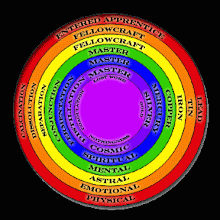
When we began out journey, we were entrenched in the lower aspects of the mind of our own creation, the realm of the Entered Apprentice.
At this level, as if blinded, we are ego driven individuals, but something in our heart causes us to knock.
“His soul pierces through the shadows of materialism and earthiness toward the Light for which his search has begun. He is prepared for his onward and upward course in Freemasonry.”
In the mind of the Entered Apprentice, the motivating forces, or first three stages of ego are:
Physical survival – meeting the individual’s basic physiological needs so that he or she can survive one more day.
Relationships – meeting the individual’s basic emotional need for love and belonging so that he or she can feel safe and protected.
Self-esteem – meeting the individual’s basic emotional need for respect so that he or she can feel as sense of self-worth.
From the ego’s perspective, all three of these needs are dependency-based. We satisfy them by trying to get what we want from the external world.
Why do so many remain ego driven, and in the dark? Our maps are very difficult to change because our ego is absolutely convinced that its own personal map is the correct view or understanding of reality. As a result, we often find ourselves passionately defending the maps and beliefs we learned in childhood from adults we trusted. We do not often remember how or where we learned a particular belief in childhood because we simply assumed that the adults in our lives knew what they were talking about. We just accepted their wisdom.
The human face of that ego is pride; is arrogant self-importance; is narcissistic self-infatuation; is the need to see oneself as being separate at all times, in all places, through all circumstances, the world of the uninitiated.

It is my belief that the Fellowcraft degree represents transformation, the purposeful move or transformation from ego centered consciousness to soul, or spirit, development. The Fellowcraft Degree addresses the mind and its faculties. We are instructed in the Seven Liberal Arts and Sciences, which were formulated hundreds of years ago in order to develop and perfect the mental nature. The intention was to prepare the mind for spiritual truths. Light is now beginning to break through.

After one is raised (the symbolic death journey from ego to unity) as a Master Mason, the truth should become self evident of the pitfalls and shortcomings of the ego based consciousness. It is at this level the motivating forces that correspond to the first three stages in the unfolding of the human soul are understood:
Internal cohesion – finding personal meaning in life by uncovering and integrating the motivations of the soul.
Making a difference – acting out the soul’s motivations by making a difference in the lives of other individuals or the community through the expression of our unique abilities.
Service – when making a difference becomes a permanent way of life we enter the path of self-less service

To put it simply, Freemasonry is a path from mind to heart, love, relief, & truth.

Wednesday, December 17, 2008

Masonic Symbols 101 (A MUST)


You have to check out this gentleman’s videos, they are truly informative! If he isn’t a Mason, he sure should be one!

Monday, December 15, 2008

Our Favorite Metalsmith - Tubal Cain


I couldn’t help but notice the two poems below may look the same, but read them carefully, both were written by Brother Mackey. Although I am sure they were meant to be the same, the endings would certainly convey a different message.

Old Tubal Cain was a man of might
In the days when Earth was young;
By the fierce red light of his furnace bright
The strokes of his hammer rung;
And he lifted high his brawny hand
On the iron glowing clear,
Till the sparks rushed out in scarlet showers,
As he fashioned the sword and spear.
And he sang, "Hurrah for my handiwork!
Hurrah for the spear and sword!
Hurrah for the hand that shall wield them well,
For he shall be king and lord!"
To Tubal Cain came many a one,
As he wrought by his roaring fire,
And each one prayed for a strong steel blade
As the crown of his desire:
And he made them weapons sharp and' strong,
Till they shouted loud for glee,
And gave him gifts of pearl and gold,
And spoils of the forest free.
And they sang, "Hurrah for Tubal Cain,
Who hath given us strength anew!
Hurrah for the smith, hurrah for the fire,
And hurrah for the metal true!"
But a sudden change came o'er his heart
Ere the setting of the sun,
And Tubal Cain was filled with pain
For the evil he had done;
He saw that men, with raga and hate,
Made war upon their kind,
That the land was red with the blood they shed
In their lust for carnage blind.
And he said, "Alas! that ever I made,
Or that skill of mine should plan,
The spear and the sword for men whose
joy
Is to slay their fellow-man."
And for many a day old Tubal Cain
Sat brooding o'er his woe;
And his hand forbore to smite the ore,
And his furnace smoldered low.
But he rose at last with a cheerful face,
And a bright, courageous eye,
And bared his strong right arm for work,
While -the quick flames mounted high.
And he sang, "Hurrah for my handicraft!"
And the red sparks lit the air;
"Not alone for the blade was the Bright steel made";
And he fashioned the first ploughshare.


TUBAL CAIN #2

Old Tubal Cain was a man of might
In the days when the earth was young;
By the fierce red light of his furnace bright
The strokes of his anvil rung ;
And he lifted high his brawny hand
On the iron growing clear,
Till the sparks rushed out in scarlet showers,
As he fashioned the sword and spear.
And he sang, " Hurrah for my handiwork !
Hurrah for the spear and the sword !
Hurrah for the hand that shall wield them well,
For he shall be king and lord ! "
But a sudden change came o'er his heart
Ere the setting of the sun ;
And Tubal Cain was filled with pain
For the evil he had done.
He saw that men, with rage and hate,
Made war upon their kind ;
That the land was red with the blood they shed
In their lust for carnage blind.
And he said, "Alas ! that I ever made,
Or that skill of mine should plan,
The spear and the sword for men whose joy
Is to slay their fellow-man! "
And men, taught wisdom from the past,
In friendship joined their hands,
Hung the sword in the hall, the spear on the wall,
And ploughed the willing lands ;
And sang, "Hurrah for Tubal Cain !
Our stanch good friend is he ;
And for the ploughshare and the plough,
To him our praise shall be.
But while oppression lifts its head,
Or a tyrant would be lord,
Though we may thank him for the plough,
We '11 not forget the sword."

Friday, December 12, 2008

Adi Da Samraj (November 3, 1939 – November 27, 2008)

Some of you may be familiar with Adi Da and some may not. No matter, the sad news is that he has passed (30 Non 2008).

The first time I was introduced to the writings and thoughts of this man was through the writings of Ken Wilber. He was a fascinating man, with a true depth. I hope you enjoy some of his thoughts:
“You spend your entire life within the dream, within this vast adventure, to find the princess in the crystal palace and save her from the dragon, or to wait in the crystal palace to be rescued by the prince. You live an endless, endless adventure, millions and millions of ages, year after year after year, of numberless complications. But at some point along the way, you become serious enough to examine your motivation to seek, to examine the cause, the root, for which this goal is only the symbol. At last one realizes that one cannot find one’s symbolic satisfaction. And this falling into one’s dilemma, then falling through it, is the unqualified Intuition of one’s Ultimate Nature and Real Condition. . . . “The waking state promises something relatively undesirable to one who is suspended in the twilight state of a pleasant dream. Such a one is reluctant to understand, too distracted to be interested in understanding. The ordinary reluctance of people is not truly caused by a premonition that the life, or sadhana, of understanding is so difficult. It is only that they do not yet care about it. Somehow, for the moment, everything seems all right. For the most part, the usual man or woman possesses a relatively healthful physical life, with certain satisfactions, certain opportunities, things to do, books to read, a future of places, physical pleasures, mental pleasures. With all of that, who wants to Awaken? And most people come to Me in that condition. Therefore, I do not take them seriously. I know they are only indulging themselves, even if to others the new arrivals seem to deserve only mercy and the grin of promised salvation. When these seekers come to Me, they make all kinds of complaints about their fundamental suffering. ‘Please give me this salvation, this realization, this release!’ But they are not really looking for that. They are unwilling to endure the discipline of Truth.

“There are certain limitations to the entire adventure and pleasure of ordinary life. You know you are going to die some time, but, essentially, mysteriously, life still seems to be full. Thus, Truth is not likely to enter the usual picture without the intervention of some fundamental, transforming event. But if you are smart, if your life is generated with Conscious Intensity, you do not have to become desperate before you will turn to the Truth. Your circumstances do not have to become empty, corrupted, and diseased. You do not have to wait for the failure of life itself before you will turn to the Truth. Someone who is waiting for life to disprove itself is only indulging himself or herself. There is nothing profound about the search or suffering of such a one. But if one is smart, if one’s life is an intensity, one is always turning to Truth from birth. . . .
“When you become less concerned for your particular search, for your inwardness, for your adventure, you have simply become more sensitive to your Real Condition. You have felt the sunlight falling on your sleeping eyes. When your eyes have opened in the morning light, everything will be obvious to you. And you will know that you have never slept, that you have never dreamed, that you have never been limited to any thing that has appeared. You have never been in any condition that you have assumed. There was always only Reality Itself, your True Nature, Which is Love-Bliss, Consciousness, the Unqualified Intensity.”
–Adi Da, The Method of the Siddhas, pp. 261-265


How about a different point of view on LIGHT!


Wednesday, December 10, 2008

Vampires In America?

Would you consider this the dumbing down of America?

In 2005, Jerry Falwell, chancellor of Liberty University awarded Hannity an honorary degree, the Nobel for dummies.

Monday, December 8, 2008

What Is So Evil About The Rights of Man

Give a man a pen and you will never know what he may write. As I was exploring the tie between naturalism and Freemasonry, I happened upon this article below. What I found interesting was how the author states, “the Declaration of the Rights of Man had been conceived and elaborated in the Masonic lodges before it was presented to the States-General of France. Accordingly, the infamous Declaration, a naturalistic or anti-supernatural document, is in reality a declaration of war on membership of Christ and on the whole structure of society based on that supernatural dignity.”
After you read his opinion, please read the Declaration and ask yourself what are they so afraid of?

Father Denis Fahey (1883-1954)a priest who resided in Ireland his entire life, explained some aspects of Judeo-Masonry this way:
There is unorganized opposition to the supernatural life of grace in each one of us, owing to the fall. This unorganized opposition of individuals leads to the formation of little anti-supernatural groups here and there, even without the concerted action of vast organized forces. The existence of united anti-supernatural action on the part of organized bodies is so far removed from the mind of the average Catholic that it needs to be stressed particularly and its aims made clear. The Christian framework of society is destined not only to aid us in attaining union with Christ but to serve as a bulwark against the assaults of the forces organized against our supernatural life. These forces are three in number, one being invisible, the other two visible. The invisible host is that of Satan and the other fallen angels, while the visible forces are those of the Jewish nation and Freemasonry.
(my note: The word for Satan in the Old Testament Hebrew was ha-satan which meant "The adversary." In the Old Testament, Andrew Collins tells us that "this term is used exclusively to describe either the enemies of God or the enemies of the Israelite race in general. Never is the Devil referred to as the evil one. Not until the advent of the New Testament...does the term ha-satan take on the all important role. At this point, Satan becomes an angel fallen from grace and expelled from heaven" (1).
Dr. George Lamsa, now deceased Aramaic scholar, also confirms that the term Satan simply means adversary or evil intent. It was NOT a literal person. It started out as a term to describe anyone who was an enemy or in an adversarial relationship, and was finely honed down into a literal being in the New Testament.)


More from Father Dennis Fahey:
The Jewish nation is not only a visible organization, but its naturalistic or anti-supernatural character is openly proclaimed by its refusal to accept the supernatural Messiahs and by its looking forward to a naturalistic messianic era. The Masonic society or group of societies is a visible organization, but its naturalistic or anti-supernatural character is secret or camouflaged. The naturalism or anti-supernaturalism of its aims, as well as of its ritual and symbolism, is clearly grasped by only relatively few of the initiated. The pantheistic deification of man, which is the consequence of this naturalism, is the supreme secret of Freemasonry. Both of these visible societies, however, make use of subterfuge and secrecy in their modes of action against the supernatural life of the nations of the world. Accordingly, the most vitally real struggle in the world is that waged by those naturalistic or anti-supernatural armies, under the leadership of Satan, against those who accept the supernatural life of grace, participation of the life of the Blessed Trinity, under the leadership of our Lord Jesus Christ. (From Chapter 5, The Kingship of Christ and the Conversion of the Jewish Nation)

(Pope Leo giving the peace sign)


In his Encyclical letter on Freemasonry, Pope Leo XIII teaches authoritatively: “From what we have already set forth, it is indisputably evident that their [the Freemasons’] ultimate aim is to uproot completely the whole religious and political order of the world, which has been brought into existence by Christianity, and to replace it by another in harmony with their way of thinking. This will mean that the foundation and the laws of the new structure of society will be drawn from pure naturalism.” Now, it is historically certain that the Declaration of the Rights of Man had been conceived and elaborated in the Masonic lodges before it was presented to the States-General of France. Accordingly, the infamous Declaration, a naturalistic or anti-supernatural document, is in reality a declaration of war on membership of Christ and on the whole structure of society based on that supernatural dignity. The same naturalistic hostility to membership of Christ and the supernatural life of grace runs through all the documents concerning human rights drawn up under the influence of the organized forces that were responsible for the Declaration of 1789. That is the real struggle going on in the world, and in it every member of Christ is called upon to play his or her part. There can be no neutrality. “He that is not with me is against me” (St. Matthew XII, 30.) -- (From Chapter 2, The Kingship of Christ and the Conversion of the Jewish Nation)


(This sure makes our fraternity look bad. That is until you actually read the Declaration of the Rights of Man!)

Approved by the National Assembly of France, August 26, 1789
The representatives of the French people, organized as a National Assembly, believing that the ignorance, neglect, or contempt of the rights of man are the sole cause of public calamities and of the corruption of governments, have determined to set forth in a solemn declaration the natural, unalienable, and sacred rights of man, in order that this declaration, being constantly before all the members of the Social body, shall remind them continually of their rights and duties; in order that the acts of the legislative power, as well as those of the executive power, may be compared at any moment with the objects and purposes of all political institutions and may thus be more respected, and, lastly, in order that the grievances of the citizens, based hereafter upon simple and incontestable principles, shall tend to the maintenance of the constitution and redound to the happiness of all. Therefore, the National Assembly recognizes and proclaims, in the presence and under the auspices of the Supreme Being, the following rights of man and of the citizen:
Articles:
1. Men are born and remain free and equal in rights. Social distinctions may be founded only upon the general good.

2. The aim of all political association is the preservation of the natural and imprescriptible rights of man. These rights are liberty, property, security, and resistance to oppression.

3. The principle of all sovereignty resides essentially in the nation. No body nor individual may exercise any authority which does not proceed directly from the nation.

4. Liberty consists in the freedom to do everything which injures no one else; hence the exercise of the natural rights of each man has no limits except those which assure to the other members of the society the enjoyment of the same rights. These limits can only be determined by law.

5. Law can only prohibit such actions as are hurtful to society. Nothing may be prevented which is not forbidden by law, and no one may be forced to do anything not provided for by law.

6. Law is the expression of the general will. Every citizen has a right to participate personally, or through his representative, in its foundation. It must be the same for all, whether it protects or punishes. All citizens, being equal in the eyes of the law, are equally eligible to all dignities and to all public positions and occupations, according to their abilities, and without distinction except that of their virtues and talents.

7. No person shall be accused, arrested, or imprisoned except in the cases and according to the forms prescribed by law. Any one soliciting, transmitting, executing, or causing to be executed, any arbitrary order, shall be punished. But any citizen summoned or arrested in virtue of the law shall submit without delay, as resistance constitutes an offense.

8. The law shall provide for such punishments only as are strictly and obviously necessary, and no one shall suffer punishment except it be legally inflicted in virtue of a law passed and promulgated before the commission of the offense.

9. As all persons are held innocent until they shall have been declared guilty, if arrest shall be deemed indispensable, all harshness not essential to the securing of the prisoner's person shall be severely repressed by law.

10. No one shall be disquieted on account of his opinions, including his religious views, provided their manifestation does not disturb the public order established by law.

11. The free communication of ideas and opinions is one of the most precious of the rights of man. Every citizen may, accordingly, speak, write, and print with freedom, but shall be responsible for such abuses of this freedom as shall be defined by law.

12. The security of the rights of man and of the citizen requires public military forces. These forces are, therefore, established for the good of all and not for the personal advantage of those to whom they shall be intrusted.

13. A common contribution is essential for the maintenance of the public forces and for the cost of administration. This should be equitably distributed among all the citizens in proportion to their means.

14. All the citizens have a right to decide, either personally or by their representatives, as to the necessity of the public contribution; to grant this freely; to know to what uses it is put; and to fix the proportion, the mode of assessment and of collection and the duration of the taxes.

15. Society has the right to require of every public agent an account of his administration.

16. A society in which the observance of the law is not assured, nor the separation of powers defined, has no constitution at all.

17. Since property is an inviolable and sacred right, no one shall be deprived thereof except where public necessity, legally determined, shall clearly demand it, and then only on condition that the owner shall have been previously and equitably indemnified.
(I don't know about you, but that sounds pretty good to me!)

Sunday, December 7, 2008

How About A Little Fear

Are you afraid?
According to the boob tube, and just about every other talking head that works behind a microphone, you should be afraid.
Just the other night, as I was lying in bed, I was listening to one of the late night radio talk shows featuring the author/minister of the Purpose Driven Life. As I lay almost asleep, I thought I heard him say something disturbing, but I wasn’t actually sure.
I woke myself up, turned up the radio and listened intently.
I’ll be dammed if he didn’t say it again!
Not believing what I just heard from a minister, a so-called man of G**d, and
because the hour was getting late, I wrestled my mind to a manageable level and drifted of to sleep.
The essence of his babble was, no matter how good you live your life, no matter what good you do for humanity, even if you live a truly spiritual life dedicated to humanity, if you are not a Christian you are going to Hell.
And this is from a man of G**d!
This talk show made me think, not about the idea of Christian dogma, but about the idea of fear, how fear has become so prevalent, controlling, and addictive, and in Pastor Warren’s world G**d was using fear to control, if you didn’t believe his son was the savior you were doomed, no matter how just and compassionate you were. How absurd!
One need only look at the body and mind experience when one experiences fear, the body and mind go into fight or flight response, a natural response to and for the survival of all sentient beings, or Darwin would say the species.
As a meditation teacher, it has been my experience that the ability to access higher states of consciousness is near impossible when the body and mind is in fight or flight. In essence, you are functioning from your lower primal consciousness, a consciousness that is contracted in self, what I would call the little mind, totally egocentric.
One need only look around, and listen, people are living fearful lives. The boob tube is filled with talk show hosts using words like terrorist, WMD, recession, unemployment, Hell and on and on, all causing viewers and listeners to shrink into primal consciousness. We have preachers and pastors scaring the shit out of already paranoid people telling them of the gloom and doom that awaits those that do not believe in their absurd doctrines. Look at the faces of those walking through the aisles of stores and shopping centers, how many are smiling?
Not many, they are all stuck in their primal conscious, afraid to open up to the unity that is the real G**d, you call that a purpose driven life.
Misery loves company!
In closing, to those that believe only a certain few will rise to heaven, enjoy your little mind, as for me, I’ll see you all in Nirvana!


Recommended reading: Our Animal Instinctual Passions in the Primitive Brain

Friday, November 28, 2008

Feeling A Little Sad Today

As I watched the events unfold in Mumbai the last couple of days, I felt ill. Do not get me wrong, I know that ignorance has been around as long a recorded history, but when are we going to look at ignorance as the disease it is and attempt to find the cure?
As I searched the web for answers, I came across this wonderful insight on the International Association of Sufism website:
"There is always someone who, desirous of power and craving bloodshed, actively manipulates others by fanning the flames of misdirected religious fervor. The only solution when this kind of virus attacks the body of the whole, is to rely on the immune system to return health to the body, which in this case is wisdom.
We must ask ourselves: what condition nourishes the anger, hatred, greed, and other harmful qualities of those who like conflict?

The answer, quite simply, is ignorance. They remain on the superficial level, allied to names, impressed by titles, and bound to inherited systems of belief, and can easily become trapped in a tower of preconceived ideas that's mortared by their own imagination. This tower becomes a strong fortress, which they feel a primal urge to defend. They think that what they believe is right and what others believe is wrong and they look for evidence to prove their "rightness." Yet anyone who is trapped in this tower is wrong, for the fortress is an illusion.
Do we want to live in peace? If so, we each must search beyond titles and inherited systems of belief - all those things which divide us - and begin instead to truly practice Islam: submission of the false ego to the One, the source of mercy, peace and love. In such a state of unity, a state which must be actualized within, internal and external fractures heal, labels lose their meaning and power, and divisive ideology melts away."

The International Association of Sufism

"War is as outmoded as cannibalism, chattel slavery, blood feuds, and dueling, an insult to God and humanity...a daily crucifixion of Christ." -- Muriel Lester
Muriel Lester accompanied Mahatma Gandhi on his tour of earthquake-shaken regions in Bihar on his anti-untouchables tour during 1934.

Tuesday, November 18, 2008

There Is An Alien in Indra’s Net

(Image: Now this is what I call a checkered floor!)

As much as I try, I just cannot seem to get away from those darn conspiracy theorists. I am not kidding, it does not matter what subject I attempt to research on the web, they pop up everywhere.
Do not get me wrong, I do find most entertaining, especially the ones about Freemasons being controlled by the invisible Illuminati (6,410,000 hits located on Google), but please, how is a grown man suppose to research various philosophers’ when the web has become a haven loony tunes?
As one who believes we are all connected, and the only reason individuality exists is because of perception, I am perplexed why parts see the world as a mass conspiracy and base their intelligence on something somebody told them, which was probably erroneous and unverifiable in the first place.
Now I realize it is not my place to set the record straight as far as Freemasonry goes, even though I know it would be fun, it would be a fool’s game and only fall on deaf ears.
I enjoy a good fairytale as much as the next man, so much so I even bought some light reading by an author named David Icke (1,100,000 hits located on Google), now I no we are in trouble! Since I paid the money, I read the book.
I really do not think it would serve any purpose reviewing what I read, at least intellectually, and please do not buy it, it would be better to give your money away. Let me just say it was entertaining in a dumbing down way, if you actually believe in the alien domination.
I sure hope he donates some of his profits to doing some good on the planet (at least before the aliens take over).

Just the other day I had a young man sitting in my chair (I cut hair), and he started asking me questions about our impending doom. He was sure the Mayans had foretold the end of existence by 2012 (3,520,000 hits located on Google). I’m not sure, but for some reason this young lad seems to think I have some direct pipeline with the overlords and usually comes in with the strangest conspiracies.
As I reassured him that the world would still be around in 2012.
He had a tough time believing me. I told him I believed the only reason the Mayan calendar stopped in 2012 was because the calendar makers had to stop some where. Imagine spending a whole life making calendars, how boring.
After his haircut, I gave him my used David Icke book.

For all those crazies that actually believe that they are the center of the universe:
In an interview with Phil Donahue in 1984, Brother Norman Vincent Peale said: "It's not necessary to be born again. You have your way to God; I have mine. I found eternal peace in a Shinto shrine. ... I've been to the Shinto shrines, and God is everywhere." Donahue exclaimed, "But you're a Christian minister; you're supposed to tell me that Christ is the Way and the Truth and the Life, aren't you?" Peale replied, "Christ is one of the ways! God is everywhere."
That a boy Brother Norman!
If Phil would have interviewed me I would of told him about the Avatamsaka Sutra
(Avatamsaka Sutra, Indra 2,190 hits located on Google)
Far away in the heavenly abode of the great god Indra, there is a wonderful net, which has been hung by some cunning artificer in such a manner that it, stretches out indefinitely in all directions. In accordance with the extravagant tastes of deities, the artificer has hung a single glittering jewel at the net’s every node, and since the net itself is infinite in dimension, the jewels are infinite in number. There hang the jewels, glittering like stars of the first magnitude, a remarkable sight.
If we now arbitrarily select one of these jewels for inspection and look closely at it, we will discover that in its polished surface there are reflected all the other jewels in the net, infinite in number. Not only that, but also each of the jewels reflected in this one jewel is also reflecting all the other jewels, so that the process of reflection is infinite.

Sunday, November 16, 2008

Climbing Jacob's Ladder - The Ladder of Freemasonry

image by "A Son of the Light"
Long before I became a Freemason, I had always been fascinated by the esoteric symbolism of the ladder. In fact one the very first blogs I had ever written was about the imaginary ladder all sentient beings existed on.
Sadly, I erased the blog, so I'll try to give it another shot.
As I said, all of us are living on this imaginary ladder, let us call it an invisible magical ladder. Now just because you cannot see it, don’t think it does not exist, let me help you envision it.
This magical invisible ladder is made out of wood, natural and organic. It reaches high, and I mean really high, so high the builder of this ladder knew that in order to hold all of humanity this ladder would have to be designed with the maximum amount of support. To allow for the growing population, and just in case of stagnation by certain climbers, the creator decided the ladder would be larger at the bottom, and slowly narrow towards the top.
So here, we have this huge ladder, made of invisible wood, large and wide at the bottom, narrow at the top, reaching towards the symbol of the creator, who we will call the G.A.O.T.U. (Remember the symbol, the Sun, hot, radiant, and light.)
The reason the ladder exists, to climb. Where are we going? To merge with the ultimate (or you can call it Nirvana, Christ Consciousness, or whatever unity principle you decide to choose).
So here we have ALL of humanity on this invisible magic ladder, each and every one of us. Yet not all of us are on the same rung. Some have climbed closer to the Sun, while others have chosen to stay put. Some people like to climb, others don’t, and the truly spooky ones are the ones that think they have climbed to the top when they have really only climbed a few rungs. When you encounter these non-climbing individuals, watch out, they will try like Hell to convince you that where they stand is the path.
Sadly very few will ever make it to the top, the ladder assuredly gets narrower and steeper as you climb, there will be less and less helping hands as you climb, due to the fact too many individuals get hung up for various reasons on certain rungs.
Have you ever wondered why people say “I don’t get it.”, its because we are not always on the same rung.
Now let me tell you about something I fear.
Remember, our invisible imaginary ladder is made out of wood, climbing to the radiant heat of the Sun. What would happen if too many individuals are stuck on a certain rung of the ladder, say the ignorance rung? How would the Sun penetrate through the mass of ignorance, without the heat of the Sun the invisible magic ladder would surely rot?

The image on this blog was created by me, agree or disagree it is something to think about!

The following are ladder references from various Masonic sources.

LADDER. A symbol of progressive advancement from a lower to a higher sphere, which is common to Masonry, and too many, if not all, of the ancient Mysteries.

LADDER, BRAHMINICAL. The symbolic ladder used in the Mysteries of Brahma. It had seven steps, symbolic of the seven worlds of the Indian universe.

LADDER, MITHRAITIC. The symbolic ladder used in the Persian Mysteries of Mithras. It had seven steps, symbolic of the seven planets and the seven metals.

LADDER, SCANDINAVIAN. The symbolic ladder used in the Gothic Mysteries. Dr. Oliver refers it to the Yggrasil, or sacred ash tree. But the symbolism is either very abstruse or very doubtful.
LADDER, THEOLOGICAL. The symbolic ladder of the Masonic Mysteries. It refers to the ladder seen by Jacob in his vision, and consists, like all symbolical ladders, of seven rounds, alluding to the four cardinal and the three theological virtues.

In the Persian mysteries of Mithras, there was a ladder of seven rounds, the passage through them being symbolical of the soul's approach to perfection. These rounds were called gates, and, in allusion to them, the candidate was made to pass through seven dark and winding caverns, which process was called the ascent of the ladder of perfection. Each of these caverns was the representative of a world, or state of existence through which the soul was supposed to pass in its progress from the first world to the last, or the world of truth.

Among the Kabbalists. the ladder was represented by the ten Sephiroths, which, commencing from the bottom, were the Kingdom Foundation, Splendor, Firmness, Beauty, Justice, Mercy, Intelligence, Wisdom, and the Crown, by which we arrive at the En Soph, or the Infinite.
From the illustrated manuscripts of St. John Climacus — one of them shows monks climbing the heavenly ladder of virtues and welcomed at the top by Christ or by an angel, while winged demons try to pull them down and make them fall into the jaws of a dragon below, which represents hell.

Monday, November 10, 2008

Beauty - The Active Principle - The Active Pillar

“The Masonic Lodge, bounded only by the extreme points of the compass, the highest heavens, and the lowest depth of the central abyss, is metaphorically supported by three great pillars, which are denominated WISDOM, STRENGTH, and BEAUTY: because there should be wisdom to contrive, strength to support, and beauty to adorn all great and important undertakings.” (General Ahiman Rezon, by Daniel Sickels, [1868])

That sounds about right at least that is what we are taught. However, what if wisdom, strength, and beauty had another elusion.
In this blog, I thought it would be fun to look at the pillar of “Beauty”, and maybe shed a different light on one of the three lesser lights.

“Beauty to adorn, all great and important undertakings”

I do not know about you, but the statement above seems a little vague, not all undertakings are beautiful. Why use the word “Beauty”?

For those who know me up close and personal, I bet you sense where I may go here, and you are right. Let us look towards the deeper meaning of “beauty”, and a good place to start is the *Kabbalah. In fact, we are heading smack dab into the center, the center of God’s chest.
If you’re not familiar with the Kabbalah, trust me, if you research carefully you will find many believe Freemasonry and Kabbalah share many common denominators. Check out this small description from The Kabbalah Center website:

Kabbalah is not a philosophy or theosophy. Kabbalah is work to be done. The kabbalists of the past were people of action, not people of theory or philosophy. They were constantly traveling from town to town, giving charity, and assisting people in creating better lives for themselves.
I am sure I’ll be addressing the similarities down the road, but for now, let’s take a look at the word beauty from the perspective of the Kabbalah and see if it could be applied to our understanding of the symbolic pillar of Beauty.
In Freemasonry, Mackey states:
Wisdom, Strength, and Beauty were honored by them as supporting pillars for the perfect accomplishment of the works; and thence they considered them symbolically as essential pillars for the support of the Lodge. Wisdom, which, established on science, gives invention to the artist, and the right arrangement and appropriate disposition of the whole and of all its parts ; Strength, which, proceeding from the harmonious balance of all the forces, promotes the secure erection of the building; and Beauty, which, manifested in God's creation of the world, adorns the work and makes it perfect."

Of the three pillars, wisdom, strength, and beauty, beauty according to the description above
“adorns the work and makes it perfect."

If we use wisdom and strength in our endeavors, the result should be beauty, but I contend “Beauty” is actually an active principle. (As is Wisdom & Strength)If we look at the Kabbalah, the sixth sefirah, Tiferet represents beauty and is associated with the center of God's chest.
Tiferet (tiferet -- which literally means "beauty" or "glory”) is the force that integrates the sefirah of Khesed ("Compassion") and Gevurah ("Overpowering"). These two forces are, respectively, expansive (giving) and restrictive (receiving). Either of them without the other could not manifest the flow of Divine energy; they must be balanced in perfect proportion (by sharing), and this is the role of Tiferet, wherein the conflicting forces are harmonized, and creation flowers forth.
As you can see, Beauty as in the Tiferet is the active principle.

“as harmony is the strength and support of all institutions”

Chesed has an innate "ideology" of goodness (loving-kindness). It wants to give for the sake of giving. It sees in this the ultimate goal, and the more one gives -- regardless who is deserving -- the greater and better things.
Gevurah, on the other hand, sees giving as poisonous (judgment) . Only things earned by equal and fair labor are "good." Thus, it has a powerful ideology of "quid quo pro" and "no free lunches." It sees the ultimate goal of creation as every creature earning its own way.
Tiferet comes along creating a synthesis of both of these approaches. It includes both these approaches because it has a broader goal in mind, and therefore makes use of both. Its goal is "the development of the human being to his greatest potential." (Kabbalah 101 Aish.Com)

I have almost finished reading a real good primer on the Kabbalah, “Nano: Technology of Mind over Matter” by Rav PS. Berg. I recommend it highly!

*Kabbalah — the world’s oldest body of spiritual wisdom — contains the long-hidden keys to the secrets of the universe as well as the keys to the mysteries of the human heart and soul.


#

Friday, November 7, 2008

Walt & June Cleaver Are Dead

There can be no denying Freemasonry has to change, as does the Republican Party. Before you go off in a tangent thinking I am linking the Freemasons with Republicans, I am making the case they both suffer from “trying to bring back” a bygone time.
For the Republicans, it seeks the days of white picket fenced homes, Ozzie and Harriet, and Walt and June Cleaver.
For the Freemasons, it was a time when the who’s who all joined the fraternity.
Both seemed to have lost sight of what there true intention was.
At its founding, the Republican Party was hardly a conservative party in the typical sense. Abraham Lincoln led a party that smashed the institution of slavery, waged all-out war, suspended and amended parts of the U.S. Constitution, launched a hugely ambitious social program known as Reconstruction, imposed a short-lived progressive income tax, as well as creating a national banking system, a Department of Agriculture, and a system of land-grant colleges. Here is how Lincoln himself, in his Second Message to Congress, characterized his party's governing philosophy: "As our case is new, so we must think anew, and act anew."Lincoln once described the difference between the Democrats and Republicans of his day as follows: Democrats, he wrote, "hold the liberty of one man to be absolutely nothing, when in conflict with another man's right of property. Republicans, on the contrary, are for both the man and the dollar; but in cases of conflict, the man before the dollar." Lincoln, of course, was referring to the slavery debate and the claim of Southern Democrats to hold a property right in their slaves.
Is this the Republican Party of today?
That is not to say they have to look back, on the contrary, "As our case is new, so we must think anew, and act anew."
As for the Freemasons, I ask what our true intent was. Was it all about our numbers?
Was it all about charity and morals?
Do I know the answers, no, but I do know we have to change, or die.
We have become a more diverse society; does your lodge reflect this diversity? By some estimates, when the year 2040 arrives the white population will be a minority in America, shouldn’t Freemasonry also reflect this shift?
These are all questions we need to address, questions very few are willing to confront.
We are Freemasons, builders of a better temple, recently on Masonic Central I heard a speaker discussing Masonry of the past, a time when all the who’s who were masons, a time this gentleman thought we should return. It was his opinion that we needed to throw more black balls. I respect his opinion, but I fear this elitist attitude is dangerous. (By the way, I highly recommend the pod-casts; they are extremely insightful and fun.) We are creating a better temple, not a temple for a select group.
Our original masons were philosophers, theologians, scientists, and thinkers. At the time the world was masculine, women could not break through. Today we have women philosophers, theologians, scientists, and thinkers, why are we excluding a group because they bare children? (Talk about a hotbed issue!) What is it we are so afraid of?

"Everything is Dual; everything has poles; everything has its pair of opposites; like and unlike are the same; opposites are identical in nature, but different in degree; extremes meet; all truths are but half-truths; all paradoxes may be reconciled." -- The Kybalion.

Sunday, November 2, 2008

Six Blind Men & Freemasonry

“What is Freemasonry” is the question I am often asked by newly made masons, and by others outside the fraternity seeking answers, a question not so easily answered considering most Freemasons actually don’t know.
When I am asked the question I usually tell them the parable of “Six Blind Men and the Elephant”, the elephant represents Freemasonry and the blind men are Masonic brothers. For those that haven’t read the parable:

Once upon a time, there lived six blind men in a village.
One day the villagers told them, "Hey, there is an elephant in the village today."
They had no idea what an elephant is.
They decided, "Even though we would not be able to see it, let us go and feel it anyway."
All of them went where the elephant was. Every one of them touched the elephant.
"Hey, the elephant is a pillar," said the first man who touched his leg.
"Oh, no, it is like a rope," said the second man who touched the tail.
"Oh, no, it is like a thick branch of a tree," said the third man who touched the trunk of the elephant.
"It is like a big hand fan" said the fourth man who touched the ear of the elephant.
"It is like a huge wall," said the fifth man who touched the belly of the elephant.
"It is like a solid pipe," Said the sixth man who touched the tusk of the elephant.
They began to argue about the elephant and every one of them insisted that he was right. It looked like they were getting agitated.
A wise man was passing by and he saw this.
He stopped and asked them, "What is the matter?" They said, "We cannot agree to what the elephant is like."
Each one of them told what he thought the elephant was like.
The wise man calmly explained to them, "All of you are right. The reason every one of you is telling it differently because each one of you touched the different part of the elephant. So, actually the elephant has all those features what you all said."
"Oh!" everyone said. There was no more fight. They felt happy that they were all right.

I must admit, I am also one of the six blind men, and my slant on Freemasonry borders on what freemasons would call “fringe masonry”, a label I wear proudly.

Saturday, October 25, 2008

Sacred Geometry - Give It A Try

You have to check out these great videos!!

(by Charles Gilchrist)


The Story of the Ritual Cat


When the spiritual teacher and his disciples began their evening meditation, the cat who lived in the monastery made such noise that it distracted them. So the teacher ordered that the cat be tied up during the evening practice. Years later, when the teacher died, the cat continued to be tied up during the meditation session. And when the cat eventually died, another cat was brought to the monastery and tied up. Centuries later, learned descendants of the spiritual teacher wrote scholarly treatises about the religious significance of tying up a cat for meditation practice.

Thursday, October 23, 2008

Tuesday, October 21, 2008

"They Will Kill Me" & The Buddha's Barber

I must admit, this truly happened to me the other day:
For those that do not know me up close and personal, I cut hair. Well, the other day I was cutting the hair of a very young man, of maybe ten years old. Beside me, overlooking stood his father, when the little one said to me “They are going to kill you!”
Looking at his reflection in the mirror, I asked whom.
“The Freemasons.” he responded sure in his answer.
I knew instantly he must have seen my ring and laughed gently.
I told him I was safe, and that I was a Freemason.
He told me, “They will kill you for saying that.”
All I could do was laugh; his father bowed his head and shook it back and forth.
From the mouth of babes!

The following is a tale of another barber. If your into meditation the story will resonate, if not, think about the message.

Buddha Gets a Haircut

Upali was born in a family of the Sudra caste so he was destined to be a slave. In ancient India, outcasts led a dog's life. An outcast must kneel aside if he happened to see the Brahmin or Ksatriya on the road. He must not peep at them; otherwise, his eyes would be dug out. If he argued with the Brahmin or ksatriya, his tongue would be cut off.
Outcasts were not allowed to receive education and hence when Upali grew up, his parents asked him to learn the skill of hair cutting to support himself. Upali was attentive and obedient hence he mastered all types of cutting in a short period. Then his parents asked someone to help arrange Upali to the palace and Upali became the barber of the princes.
Princes such as Prince Bhaddiya and Prince Aniruddha had their hair cut by Upali. They liked Upali as he handled their hair with extra care.

When Upali was twenty years old, Buddha returned to His hometown, Kapilavatthu. That was three years after the Buddha attained enlightenment.
Upali was recommended to do the haircut for Buddha. He was overwhelmed by the unexpected favor but hesitated to accept the honor, as he knew the Buddha was the Great Enlightened One and He possessed thirty-two Marks of the Saint. So he asked for his mother's advice.
His mother comforted him and said that the Buddha was benevolent and He would not despise outcaste. However, Upali was still afraid of going despite his mother's assurance. His mother could not do anything but accompanied him to do the haircut for the Buddha.

The next day, Upali, in the company of his mother, did the haircut for Buddha.
After a while, his mother knelt before Buddha and asked, "Lord Buddha, what do you think of his skill?"
"He bows too low, "
replied the Buddha.
Upali straightened his back when he heard this.
It was said that he attained the first stage of meditation.

After a while, his mother knelt down and asked,” Lord Buddha, what do you think now?"
"His body seems to be too straight,"
replied the Buddha.
When Upali heard this, he concentrated his attention and it was said that he attained the second stage of meditation then.

After a while, his mother asked the Buddha again, "Lord Buddha, what do you think of his skill now?"
"He breathes in too fast," replied Buddha.
When Upali heard this, he concentrated his mind on breathe-in and breathe-out. It was said that he attained the third stage of meditation then.

His mother asked Buddha again, "What do you think now?"
"He breathes out too fast."
replied the Buddha.
Now, Upali was mindful of breathing in and out and he did not know what he was holding a razor. It was said that he attained the fourth stage of meditation.

On the instance, the Buddha asked the Brethren to prop up Upali so that he would not fall down.
We could learn from here that Upali was very attentive in his work. He was strict with himself and could listen to people's criticisms with an open mind. Hence, he was pre-eminent among those who knew the disciplinary rules by heart.

Upali became one of the ten chief disciples of the Buddha. He asked the Buddha if a person of "low birth" such as he could join the order. Buddha ordained him before the princes and asked the princes to pay homage to Upali, who by then had become an Arhant with Buddha's sermons while Buddha was getting a haircut. He became the chief disciple in knowing the rules of the order and the foremost disciple in keeping precepts. .Later he became Buddha’s chief disciple on Vinaya (Monk Rules)